
We often hear that the secret to becoming “rich” is to get a high-paying job. We are told that if we could just earn a few extra thousand dollars a month, all our financial stress would disappear.
We have been taught a lie: that the only way to get rich is to climb the corporate ladder and earn a massive salary. While a high income helps, it is only half of the equation.
The truth is that financial freedom is a math problem, not a status symbol. It is the gap between your income and your expenses that determines how fast you cross the finish line to a work-free life. Financial freedom is not about the size of your paycheck; it is about the size of the gap between what you earn and what you spend.
If you earn $10,000 a month but spend $10,000, you are still “broke.” If you earn $3,000 but only spend $2,000, you are actually on the fast track to wealth. In this guide, we will break down how to master your spending and build your “Freedom Fund.”
Imagine two people:
- High-Earner Henry: Earns $15,000 a month but spends $14,500 on a luxury car, a mansion, and expensive clubs. He has $500 left.
- Steady Sam: Earns $4,000 a month but lives a simple life, spending $2,500. He has $1,500 left.
Even though Henry earns nearly four times as much, Sam is getting rich three times faster. If Henry loses his job, he is in a crisis within 30 days. If Sam loses his, he has a massive cushion. Financial freedom is about the flexibility your savings provide, not the brand of your shoes.
Table of Contents
1. The Danger of “Lifestyle Creep.”
The biggest enemy of your financial freedom is Lifestyle Creep. This happens when your spending rises every time your income increases.
When you get a raise, you might buy a faster car or a bigger house. Suddenly, that extra money is gone, and you are just as stressed as before. To achieve true financial independence, you must learn to keep your expenses stable even as your salary grows.
Key Takeaway: Control your lifestyle, or your lifestyle will control you.
2. Smart Budgeting: The 50/30/20 Rule
You don’t need a degree in finance to manage your money. You just need a simple structure. The 50/30/20 Rule is a world-class template for anyone starting their journey:
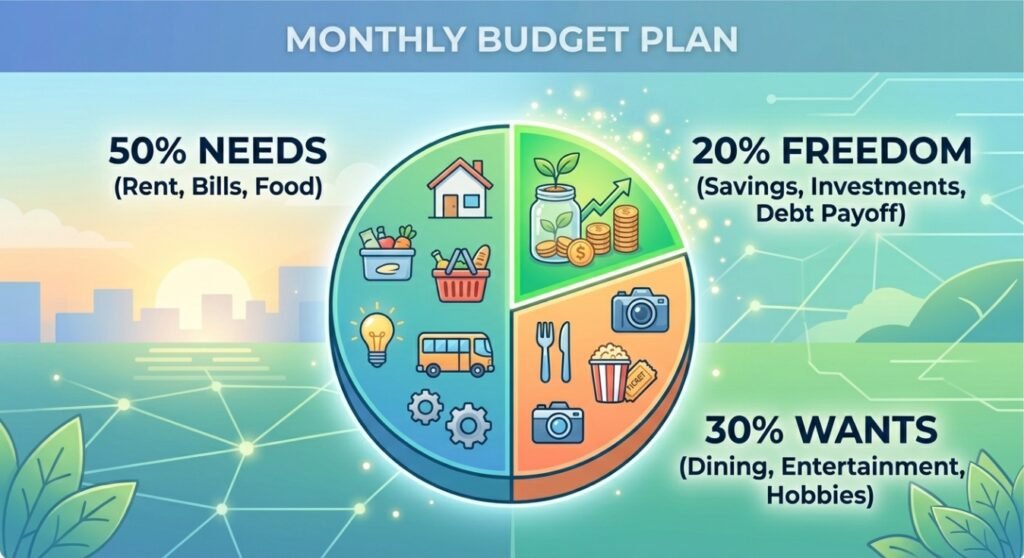
- 50% for Needs: This covers your “must-haves” like rent, groceries, utilities, and transport.
- 30% for Wants: This is your “fun money” for dining out, Netflix, and hobbies.
- 20% for Freedom: This is the most important bucket. Use this for savings, paying off debt, and investing.
Your Personalized Budget Table
Use this template to see where your money should go based on a sample $4,000 monthly income:
| Category | Goal % | Amount (Sample) |
| Needs (Rent, Food, Bills) | 50% | $2,000 |
| Wants (Dining, Hobbies) | 30% | $1,200 |
| Freedom (Savings, Investing) | 20% | $800 |
3. The “Quick Wins”: How to Cut Spending by 10% Today
Saving money doesn’t have to be painful. Here are three “Quick Wins” to plug the leaks in your budget:
- The Subscription Audit: Check your bank statement for apps or services you don’t use. Canceling just two $15 subscriptions saves you $360 a year.
- The Generic Swap: Buy store-brand items for staples like flour, salt, or cleaning supplies. They are often the exact same quality but 30% cheaper.
- The 72-Hour Rule: For any non-essential purchase over $50, wait three days. Usually, the “urge” to buy fades, and you save that money instead.
4. Why “Saving” is Better Than “Earning.”
Did you know that a dollar saved is worth more than a dollar earned? When you earn an extra dollar at work, the government takes a portion in taxes. But when you save a dollar by cutting an expense, you keep 100% of it.
Furthermore, lowering your spending lowers the “finish line” for your retirement. If you spend less every month, you need a smaller total nest egg to live comfortably without a job.
5. The Power of Your “Freedom Fund.”
What happens to that $200 you saved using our “Quick Wins”? If you invest it in a simple index fund with an 8% return, here is how it grows:

- In 5 Years: Your $200/month grows to $14,700.
- In 10 Years: It grows to $36,800.
- In 20 Years: It grows to $117,800.
- In 30 Years: It grows to $298,000.
Most of that final number is “free money” created by compound interest. By the end, your “saved” money is doing more work than you are. This is how you stop working for money and start making money work for you. And this is the definition of financial freedom.
6. The “Rule of 25”: Knowing Your Number
How do you know when you are truly free? Use the Rule of 25. Take your annual spending and multiply it by 25. That is the amount you need in investments to never have to work again.
- If you spend $40,000/year, you need $1 Million.
- If you lower your spending to $30,000/year, you only need $750,000.
By learning to be happy with less, you don’t just save money; you shorten your working life by years.
Financial Freedom is a Choice
Financial freedom isn’t a lottery you win, nor is it a dream only reserved for the 1%; it’s a habit you practice. It starts with one less impulse purchase and one more automated investment. So, it is a choice available to anyone who decides to spend less than they earn. By mastering your spending today, you are buying your freedom for tomorrow.
Disclaimer: befinanciallyfree.net/ provides educational content on wealth protection. This article is for informational purposes only and does not constitute legal, medical or financial advice. Always consult with a licensed professional regarding your specific situation.